
Anúncios
Learning to play the accordion opens up a world of musical possibilities, blending rhythm, melody, and harmony in one captivating instrument.


The accordion has charmed audiences for centuries across diverse musical genres—from European folk traditions to Latin American rhythms, jazz improvisations, and contemporary pop music. Its distinctive sound and visual appeal make it a standout instrument that never fails to captivate listeners.
Whether you’re drawn to traditional folk melodies or modern accordion arrangements, embarking on this musical journey requires dedication, proper guidance, and a genuine passion for the craft. This comprehensive guide will walk you through everything you need to know to start your accordion-playing adventure.
🎵 Understanding the Accordion’s Anatomy
Before diving into playing techniques, familiarizing yourself with the accordion’s components is essential. The instrument consists of three main sections that work together to produce its characteristic sound.
The right-hand keyboard resembles a piano keyboard and plays the melody. Depending on your accordion type, this section may feature piano keys or buttons. The left-hand side contains bass buttons arranged in a specific pattern, providing accompaniment through bass notes and pre-set chords.
The bellows connect both sides and serve as the accordion’s lungs. By pushing and pulling the bellows, you control airflow through internal reeds, creating sound. Mastering bellows control is fundamental to developing good tone quality and dynamic expression.
The reed blocks contain metal reeds that vibrate when air passes through them. Different registers activate various reed combinations, allowing you to produce diverse tonal colors and textures throughout your performance.
🎹 Choosing Your First Accordion
Selecting the right accordion significantly impacts your learning experience. Several factors deserve consideration when making this important decision.
Piano accordions feature a keyboard similar to a piano, making them intuitive for those with piano experience. Button accordions, more common in folk traditions, offer a different layout that some find more ergonomic once mastered.
Size matters considerably for beginners. Full-size accordions can be heavy and overwhelming for newcomers. Consider starting with a smaller model featuring 48 or 72 bass buttons rather than a full 120-bass instrument.
Budget constraints often influence choices. Quality used accordions from reputable brands frequently offer better value than inexpensive new models. Consult with experienced players or teachers before purchasing to avoid common pitfalls.
✋ Proper Posture and Hand Position
Establishing correct posture from the beginning prevents physical discomfort and technical limitations later. The accordion is worn rather than held, distributing weight across your torso through shoulder straps.
Sit or stand with your back straight and shoulders relaxed. The instrument should rest comfortably against your chest without slouching forward. Adjust straps so the accordion sits securely without excessive tightness that restricts breathing or movement.
Your right hand should curve naturally over the keyboard with fingers slightly bent. Keep your wrist aligned with your forearm, avoiding extreme angles that cause tension. The thumb typically rests behind the keyboard or on a thumb strap for support.
The left hand positioning differs significantly. Your wrist slides through a strap, allowing your hand to move freely across the bass buttons while maintaining stability. Your fingers should hover above the buttons, ready to depress them with controlled movements.

🌬️ Mastering Bellows Technique
Bellows control separates mediocre accordion players from accomplished musicians. This aspect of technique receives insufficient attention from many beginners, yet it profoundly affects musical expression.
Start by practicing opening and closing the bellows without playing notes. Focus on smooth, controlled movements at various speeds. The bellows should move steadily without jerky motions or sudden stops.
Coordinate bellows direction with musical phrasing. Generally, changing bellows direction coincides with natural phrase breaks, similar to a singer taking breaths. This creates musical flow rather than mechanical alternation.
Dynamic control comes primarily from bellows pressure and speed. Gentle, slow movements produce soft tones, while faster, firmer pressure creates louder volumes. Practice scales and simple melodies while consciously varying dynamics.
Avoid fully extending or compressing the bellows during performance. Maintaining reserve capacity in both directions allows flexibility for sudden dynamic changes or phrase extensions without awkward interruptions.
🎼 Reading Accordion Music Notation
Accordion music uses standard musical notation with some unique conventions. The treble clef shows right-hand melodies, while bass clef or specialized notation indicates left-hand accompaniment.
Bass notation often uses letters and symbols representing specific buttons rather than traditional note heads. The Stradella bass system, most common on standard accordions, follows a logical pattern that becomes intuitive with practice.
Bellows direction indicators appear as symbols above the staff—arrows or letters showing when to push or pull. Following these markings helps maintain smooth phrasing and prevents awkward direction changes.
Register symbols indicate which reed combinations to activate for different tonal colors. These appear as numbers or pictorial representations above the staff, guiding your timbral choices throughout the piece.
🎶 Essential Scales and Exercises
Building technical foundation through scales and exercises accelerates your progress dramatically. These fundamental patterns appear repeatedly in actual music, making practice time directly applicable to performance.
Begin with C major scale, the simplest key with no sharps or flats. Practice hands separately at first, focusing on even tone and smooth bellows control. Gradually increase tempo only after achieving consistency at slower speeds.
Add left-hand bass patterns once comfortable with right-hand scales. Simple alternating bass-chord patterns provide rhythmic foundation for countless songs across various genres.
Five-finger exercises develop independence and strength in each digit. Hanon exercises, originally written for piano, translate effectively to piano accordion with some adaptations for the instrument’s unique characteristics.
Arpeggio practice builds chord knowledge and improves finger agility. Start with major and minor triads before progressing to seventh chords and more complex harmonies.
🎵 Learning Your First Songs
Applying technical skills to actual music provides motivation and demonstrates progress. Choose pieces slightly below your current technical level initially, allowing focus on musical expression rather than struggling with notes.
Folk songs offer excellent starting material. Simple melodies with straightforward harmonies let you concentrate on tone quality, phrasing, and bellows control without overwhelming technical demands.
Break songs into manageable sections. Master small phrases thoroughly before connecting them into longer passages. This systematic approach prevents frustration and builds confidence progressively.
Play along with recordings when possible. Hearing professional interpretations provides insights into tempo, dynamics, and stylistic nuances that written notation cannot fully convey.
🎹 Developing Left-Hand Coordination
The left hand presents unique challenges for accordion students. Unlike the visible right-hand keyboard, bass buttons remain hidden beneath your hand, requiring memorization and kinesthetic awareness.
The Stradella system arranges buttons in diagonal rows. The middle row contains fundamental bass notes, with corresponding major, minor, seventh, and diminished chords in adjacent rows. Understanding this layout is crucial for efficient navigation.
Start by locating the reference button—a notched or raised button marking middle C bass. All other positions relate spatially to this landmark, allowing orientation without visual confirmation.
Practice bass-chord patterns in various keys. Common patterns like bass-chord-bass-chord or waltz patterns (bass-chord-chord) form the foundation for countless accompaniment styles.
Develop muscle memory through repetition. With consistent practice, your fingers learn to find correct buttons reliably without conscious thought, freeing mental resources for musical interpretation.
🎼 Understanding Musical Styles
The accordion shines across numerous musical traditions, each with distinct stylistic requirements. Exploring various genres broadens your musical vocabulary and makes practice more engaging.
Traditional European folk music—French musette, Italian tarantella, German polka—showcases the accordion’s cultural heritage. These styles emphasize rhythmic vitality and characteristic ornamentation.
Latin American genres including tango, forró, and norteño music feature accordion prominently. These styles often require more aggressive bellows articulation and rhythmic precision.
Jazz accordion demands advanced harmonic knowledge and improvisational skills. Players like Art Van Damme revolutionized the instrument’s role in this sophisticated genre.
Contemporary music continues embracing accordion in unexpected contexts. Indie rock, alternative pop, and world fusion projects increasingly feature accordion’s unique timbral qualities.
🎯 Effective Practice Strategies
Quality practice trumps quantity every time. Structured, focused sessions produce better results than mindless repetition, even with limited available time.
Establish regular practice schedules. Consistency matters more than session length—thirty minutes daily outperforms sporadic three-hour marathons in building skills and muscle memory.
Begin sessions with warm-up exercises. Scales, arpeggios, and technical patterns prepare your hands physically and focus your mind on musical tasks ahead.
Divide practice time strategically among technique, repertoire, and sight-reading. Balanced development across these areas prevents weaknesses from limiting overall progress.
Use a metronome regularly. Steady tempo development and rhythmic precision require objective feedback that only a metronome provides consistently.
Record your practice sessions periodically. Listening objectively to recordings reveals issues you might miss during playing, accelerating improvement through honest self-assessment.
👨🏫 Finding Quality Instruction
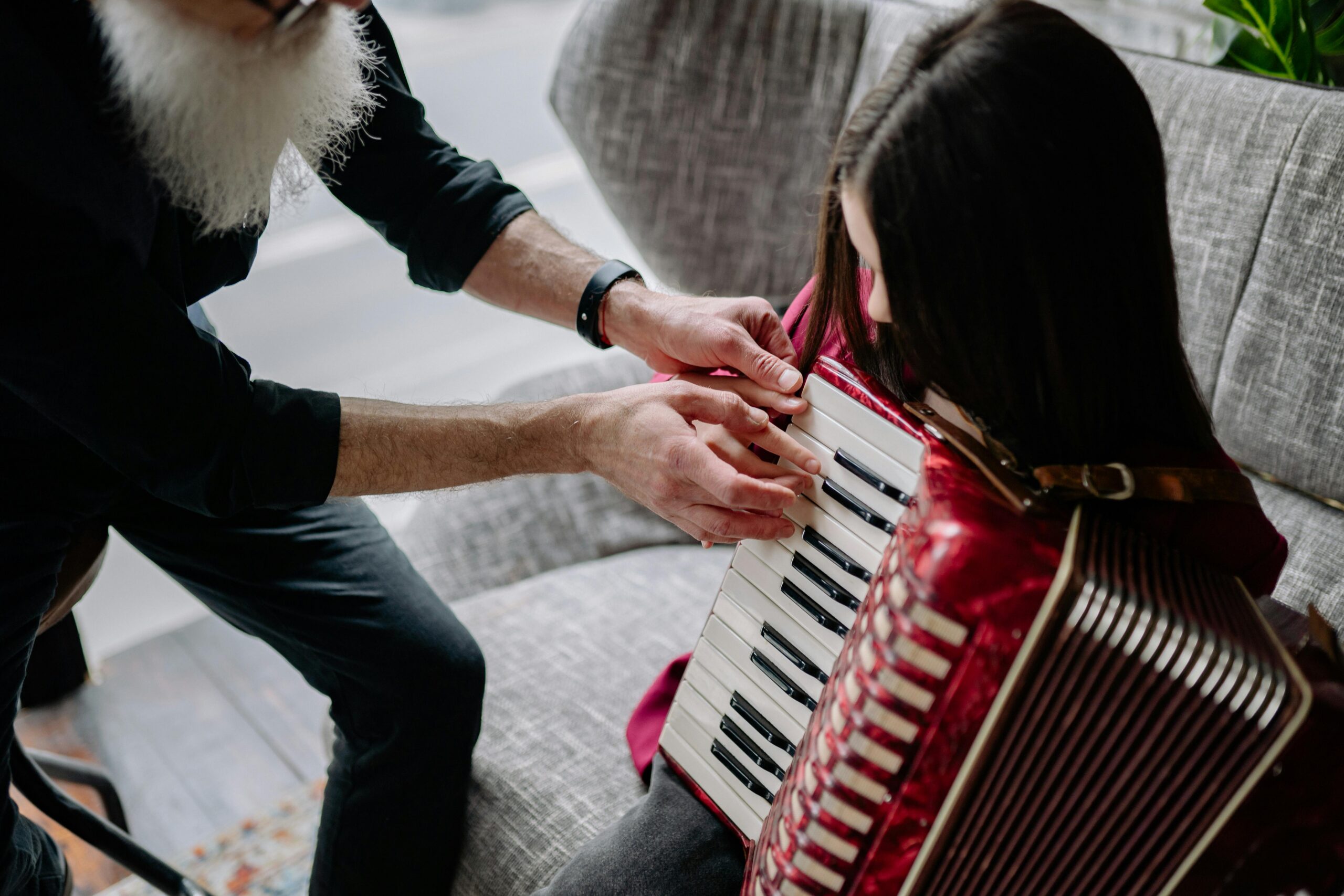
While self-teaching offers flexibility, working with an experienced teacher accelerates progress significantly. Qualified instructors identify problems before they become ingrained habits and provide personalized guidance.
Look for teachers with professional performing experience. Active musicians bring practical insights and stylistic authenticity that purely academic instructors may lack.
Online lessons have expanded access dramatically. Video conferencing enables studying with teachers worldwide, though nothing completely replaces in-person instruction for beginners.
Group classes and workshops provide community and motivation. Learning alongside others creates supportive environments and opportunities to perform for sympathetic audiences.
🔧 Maintaining Your Accordion
Proper maintenance ensures your instrument remains playable and preserves its value. Regular care prevents costly repairs and maintains optimal sound quality.
Store your accordion in a stable environment away from temperature extremes and humidity fluctuations. These conditions damage reeds, wax seals, and wooden components over time.
Clean the exterior regularly with appropriate materials. Avoid harsh chemicals that damage finishes or decorative elements. Dust and dirt accumulation affects bellows seals and mechanical components.
Professional tuning and maintenance every few years keeps your accordion performing optimally. Technicians address reed tuning, valve replacement, and other issues beyond typical player maintenance capabilities.
🎤 Building Performance Confidence
Playing for others represents both challenge and reward. Performance experience transforms your relationship with music from private study to shared communication.
Start with low-pressure situations like playing for family or friends. Gradually expand to open mic nights, recitals, or community events as confidence grows.
Manage performance anxiety through preparation and mindset strategies. Thorough practice provides security, while breathing techniques and positive visualization reduce nervous tension.
Record performances when possible. Video documentation tracks progress and provides material for online sharing, expanding your audience beyond immediate physical presence.
📚 Expanding Your Musical Knowledge
Technical skill represents only part of musicianship. Developing theoretical understanding and cultural awareness enriches your playing and interpretive depth.
Study music theory fundamentals including scales, chord construction, and harmonic progressions. This knowledge illuminates patterns within pieces, accelerating learning and improving improvisational abilities.
Listen extensively to accomplished accordionists across various styles. Active listening develops your musical ear and expands your conception of the instrument’s possibilities.
Learn about accordion history and its role in different cultures. Understanding contextual background enriches your interpretations with authenticity and emotional resonance.
🌟 Staying Motivated on Your Journey
Long-term musical development requires sustained motivation through inevitable plateaus and challenges. Strategies for maintaining enthusiasm ensure continuous progress toward your goals.
Set realistic, specific goals with defined timelines. Achieving milestones provides satisfaction and momentum, while vague aspirations often lead to discouragement.
Connect with other accordion enthusiasts through online communities, festivals, and local groups. Shared passion sustains motivation and provides resources for ongoing learning.
Celebrate progress regularly, however incremental. Musical development happens gradually—acknowledging improvements maintains positive momentum through the lengthy learning process.
Remember why you started learning accordion. Whether drawn by specific musical styles, family traditions, or pure curiosity, reconnecting with your initial inspiration reignites enthusiasm during difficult periods.
The accordion journey offers lifelong rewards extending far beyond technical mastery. This expressive instrument connects you with rich musical traditions while developing discipline, creativity, and joy through artistic expression. 🎶
