
Anúncios
Learning the accordion opens a world of musical expression, connecting you to diverse cultural traditions while developing coordination, rhythm, and creativity in ways few instruments can match.


The accordion is a fascinating instrument that has captured hearts across continents, from Parisian cafés to Brazilian forró dances, from Irish pubs to Argentinian tango halls. Its unique ability to produce both melody and harmony simultaneously makes it a complete musical package in one instrument.
Whether you’re drawn to folk music, classical compositions, jazz improvisations, or contemporary pop arrangements, the accordion offers incredible versatility. This comprehensive guide will walk you through everything you need to know to start your accordion journey with confidence and enthusiasm.
🎵 Understanding the Accordion Family
Before diving into learning techniques, it’s essential to understand the different types of accordions available. Each variation serves specific musical styles and offers unique playing experiences.
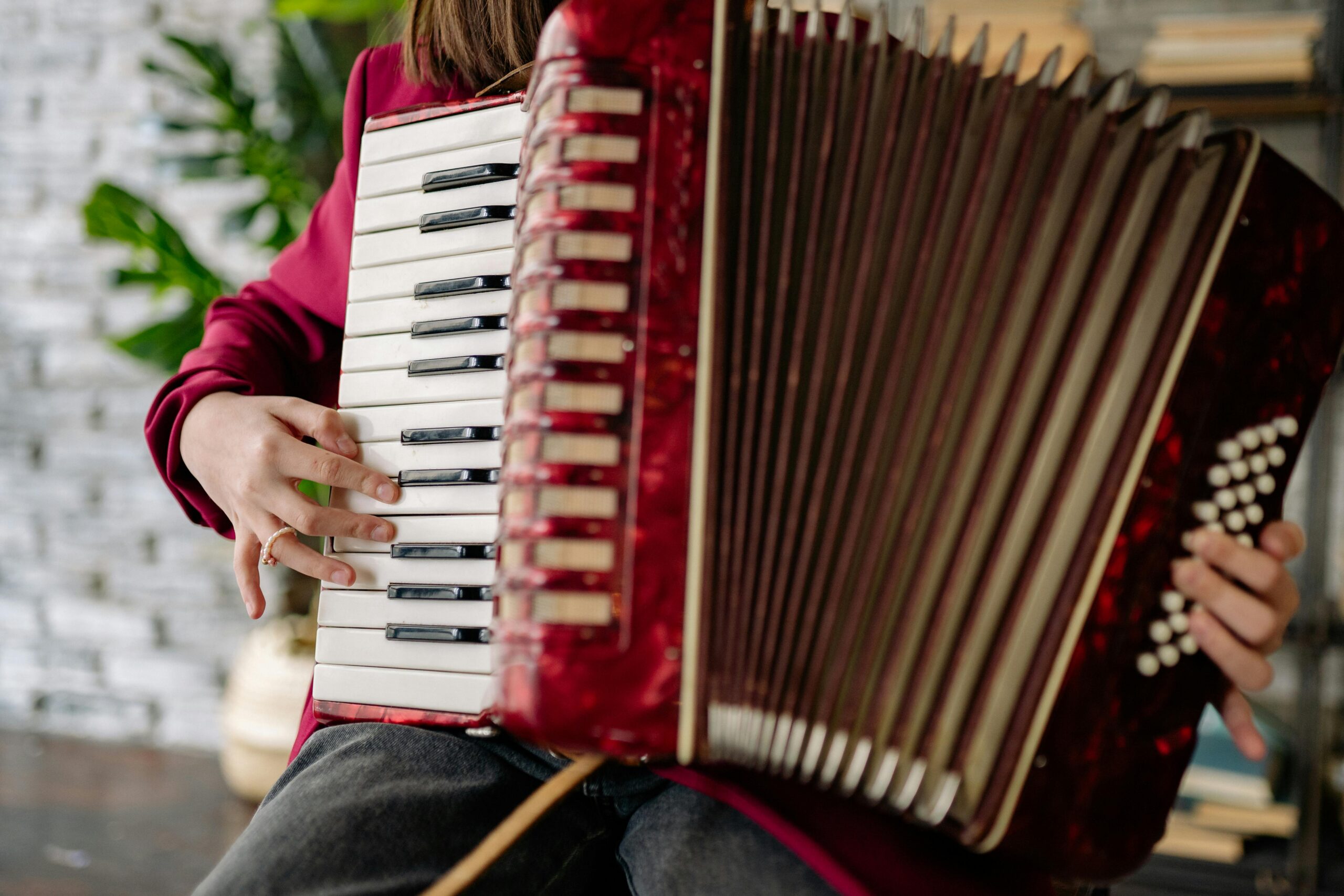
The piano accordion features a keyboard on the right side similar to a piano, making it intuitive for those with keyboard experience. The button accordion, popular in folk traditions, uses buttons instead of keys and comes in various configurations. The diatonic accordion, common in folk music worldwide, plays different notes when pushing and pulling the bellows.
Chromatic accordions offer all twelve notes of the chromatic scale in both bellows directions, providing maximum musical flexibility. Your choice depends on the music genre you want to explore, your budget, and personal preference regarding button versus keyboard layout.
🎹 Choosing Your First Accordion
Selecting the right accordion as a beginner significantly impacts your learning curve and enjoyment. Size, weight, and number of bass buttons are critical considerations.
A 48-bass or 60-bass accordion works perfectly for beginners, offering enough range without overwhelming complexity. These models are lighter and more manageable than full-sized 120-bass instruments, reducing physical strain during practice sessions.
New accordions can be expensive, often ranging from several hundred to thousands of dollars. The used market offers excellent opportunities for budget-conscious learners. Check the bellows for air leaks by closing all valves and gently pressing—quality bellows should resist without hissing sounds.
Inspect the reeds by playing each note and listening for clear, consistent tone production. Sticky or silent keys indicate needed repairs. The straps should be comfortable and adjustable, as proper positioning prevents back and shoulder strain during extended playing.
⚙️ The Anatomy of Your Instrument
Understanding how your accordion produces sound empowers better playing technique and maintenance awareness. The bellows function as the accordion’s lungs, providing air pressure that activates the reeds.
Reeds are thin metal tongues that vibrate when air passes over them, producing specific pitches. The right-hand keyboard or buttons control melody notes, while the left-hand bass system manages accompaniment, including bass notes and pre-set chord buttons.
Register switches alter tone color by activating different reed combinations, similar to organ stops. These switches expand your expressive palette, allowing everything from bright, piercing sounds to deep, rich timbres.

The bass mechanism typically follows the Stradella system, where buttons are arranged in rows representing bass notes, major chords, minor chords, seventh chords, and diminished chords. This standardized layout enables quick accompaniment patterns once memorized.
🪑 Proper Posture and Positioning
Correct posture prevents injuries and facilitates better control over your instrument. Sit upright on a sturdy chair without arms, feet flat on the floor, positioned slightly apart for stability.
The accordion should rest on your left thigh, angled slightly to the right for keyboard access. Adjust the shoulder straps so the instrument sits securely without excessive tension. Your shoulders should remain relaxed, not hunched or raised.
The right hand should hover over the keyboard with curved fingers, wrist aligned with the forearm. Avoid bending the wrist sharply upward or downward. The left hand navigates the bass buttons with the thumb secured through the thumb strap while fingers remain curved and ready.
Maintain this posture throughout practice sessions, taking breaks every 20-30 minutes to stretch and reset. Building endurance takes time, and discomfort signals the need for adjustment rather than pushing through pain.
🌬️ Mastering Bellows Control
Bellows technique separates mediocre from exceptional accordion playing. The bellows controls volume, articulation, and phrasing, functioning like breath in wind instruments or bow pressure in strings.
Begin with simple exercises: open and close the bellows smoothly while playing a single note, maintaining consistent volume and tone. Count steadily to four while opening, then four while closing, developing even tempo control.
Practice bellows changes at different speeds—slow for lyrical passages, quick for staccato effects. Bellows shake, a rhythmic pulsing technique, adds texture to sustained notes and works beautifully in folk styles.
Efficient bellows use conserves air, allowing longer phrases without changing direction. Apply just enough pressure to sound notes clearly; excessive force wastes air and creates harsh tone quality. Listen critically to your sound, adjusting pressure for musical expression.
🎼 Right-Hand Melody Fundamentals
For piano accordion players, finger technique resembles piano playing but requires adjustment for the vertical keyboard position. Number your fingers one through five, thumb to pinky.
Start with simple five-finger exercises in C major position: C-D-E-F-G using thumb through pinky. Play slowly, ensuring each note sounds clearly before moving to the next. Maintain curved fingers, striking keys with fingertips rather than flat finger pads.
Practice scales systematically, beginning with C major, then progressing through G, D, A, and F major scales. Scales build technical foundation while familiarizing you with key signatures. Use standard fingering patterns for consistency and efficiency.
Button accordion players face different challenges but follow similar principles. Learn the button layout methodically, starting with one row and gradually incorporating others. The geometric button arrangement enables rapid passages once mastered.
🎸 Left-Hand Bass Accompaniment
The Stradella bass system initially seems mysterious but follows logical organization. The first two rows contain bass notes in the circle of fifths. The remaining rows provide chord variations: major, minor, seventh, and diminished.
Begin by locating the C bass button, usually marked with a dimple or different texture. From C, move diagonally toward yourself to find the C major chord. This spatial relationship remains constant for all root notes.
Practice simple bass-chord patterns in 3/4 time: bass-chord-chord (oom-pah-pah waltz pattern). Then explore 4/4 patterns: bass-chord-alternate bass-chord. These foundational accompaniment styles apply to countless songs.
Develop independence between hands by playing sustained right-hand notes while executing left-hand patterns. Gradually introduce right-hand melodies, ensuring the left hand maintains steady rhythm without disruption.
📚 Building Your Repertoire
Selecting appropriate pieces accelerates progress and maintains motivation. Start with folk melodies and simple classical pieces arranged for beginners.
Traditional songs like “Oh! Susanna,” “Amazing Grace,” and “When the Saints Go Marching In” offer familiar melodies with straightforward harmonies. These pieces develop coordination while producing recognizable music quickly.
As skills advance, explore genre-specific repertoire. French musette waltzes showcase bellows technique and romantic phrasing. Italian tarantellas develop speed and rhythmic precision. Irish jigs and reels challenge articulation and ornamentation skills.
Classical accordion transcriptions of Bach, Scarlatti, and Mozart provide technical challenges and musical depth. Contemporary accordion compositions by composers like Astor Piazzolla blend classical technique with passionate expression.
🎯 Effective Practice Strategies
Quality practice trumps quantity every time. Thirty focused minutes surpasses hours of distracted playing. Structure practice sessions with clear objectives and varied activities.
Warm up with scales, arpeggios, and technical exercises for 10-15 minutes. This prepares muscles and focuses attention. Work on current pieces, isolating difficult passages for repetition. Slow practice solidifies accuracy before increasing tempo.
Use a metronome religiously to develop timing precision. Start at comfortable tempos where you play accurately, gradually increasing speed as passages become secure. Record yourself regularly—playback reveals issues your ears miss during performance.
Alternate between different practice elements: technique, repertoire, sight-reading, and improvisation. This variety prevents boredom and develops well-rounded musicianship. End sessions with something enjoyable, leaving you eager for tomorrow’s practice.
🎶 Reading Accordion Music Notation
Accordion music typically appears on two staves, similar to piano notation. The treble clef shows right-hand melody, while the bass clef indicates left-hand accompaniment.
Bass notation uses specialized symbols rather than traditional note heads. Letters indicate bass notes (C, F, G), while abbreviated chord symbols show chord types (M for major, m for minor, 7 for seventh chords).
Bellows direction markings appear above the staff: arrows, “push/pull” indicators, or symbols showing when to change direction. Following these markings ensures sufficient air and appropriate phrasing.
Dynamic markings (pp, p, mp, mf, f, ff) indicate volume levels, achieved through bellows pressure rather than touch velocity. Articulation marks (staccato dots, slurs, accents) guide musical expression and playing style.
🌟 Developing Musicality and Expression
Technical proficiency means little without musical expression. Musicality transforms notes into compelling communication, engaging listeners emotionally.
Study recordings of master accordionists across genres. Notice phrasing choices, dynamics, tempo flexibility, and ornamental techniques. Imitate these elements in your playing, gradually developing personal interpretive voice.
Experiment with register switches to color different musical sections. A bright register suits joyful passages, while reed combinations create melancholic atmosphere. Dynamic contrast creates musical interest—avoid playing everything at one volume level.
Rubato, slight tempo flexibility, adds expressive nuance to lyrical pieces. Accelerate through exciting sections, broaden phrases at climactic moments. Always serve the music’s emotional content rather than displaying technical prowess.
🔧 Maintenance and Care Tips
Regular maintenance extends your accordion’s lifespan and ensures optimal performance. Store the instrument in its case, away from extreme temperatures and humidity fluctuations.
Clean the exterior with a soft, slightly damp cloth after playing, removing fingerprints and dust. Avoid chemical cleaners that damage finishes. Keep the keyboard and buttons free from debris that can interfere with mechanism.
Check bellows corners and folds periodically for wear. Small tears require immediate professional repair to prevent expansion. Never force bellows open beyond natural extension or close with excessive pressure.
Professional tuning and maintenance every few years keeps reeds responsive and correctly pitched. Reeds gradually go out of tune through normal playing, and wax securing reeds can deteriorate. Trust qualified accordion technicians for internal work.
🤝 Connecting with the Accordion Community
Learning accelerates through community involvement. Online forums, social media groups, and local accordion clubs provide support, resources, and performance opportunities.
YouTube offers countless tutorial videos, performances, and masterclasses from world-class players. Follow accordionists in genres you enjoy, studying their technique and repertoire choices.
Attend accordion festivals and workshops when possible. These events offer intensive learning, networking, and inspiration from fellow enthusiasts. Many feature beginner-friendly sessions and instrument vendors.
Consider finding a qualified accordion teacher, either locally or through online lessons. Personalized instruction addresses specific challenges and prevents bad habits from developing. Teachers provide accountability and structured learning paths.
🚀 Setting Realistic Goals and Tracking Progress
Goal-setting provides direction and motivation throughout your accordion journey. Establish short-term objectives (weekly or monthly) and long-term aspirations (yearly or beyond).
Short-term goals might include mastering a specific scale, learning a new piece, or improving bellows control. Long-term goals could involve performing publicly, joining an ensemble, or mastering a particular style.
Document progress through practice journals, recording dates, pieces studied, and technical challenges addressed. Review entries monthly to recognize improvement—progress often feels invisible day-to-day but becomes evident over weeks and months.
Celebrate milestones, regardless of size. Completing your first piece, performing for family, or successfully navigating a difficult passage deserves recognition. Positive reinforcement sustains motivation through inevitable plateaus.
🎭 Performance Preparation and Stage Presence
Eventually, you’ll want to share music with others, whether informally for friends or in formal concert settings. Performance preparation reduces anxiety and increases success likelihood.
Memorize pieces thoroughly before performing, practicing until you can play confidently without sheet music. Mental rehearsal—visualizing performances without the instrument—strengthens memory and builds confidence.
Practice performing in various conditions: standing, sitting, with background noise, under time pressure. This prepares you for unpredictable performance environments. Record mock performances to identify weaknesses.
Stage presence matters beyond playing notes correctly. Make eye contact with listeners, smile, and project enjoyment. Audiences forgive technical imperfections when performers communicate genuine musical passion.
🌈 Exploring Musical Styles
The accordion’s versatility shines across countless genres. Exploring different styles expands technical abilities and musical appreciation.
French musette epitomizes romantic accordion sound, featuring flowing waltzes and sentimental melodies. Italian folk music bursts with energy, incorporating rapid passages and rhythmic vitality. Cajun and Zydeco styles from Louisiana blend French, Caribbean, and American influences into infectious dance music.
Tango accordion, particularly in Piazzolla’s compositions, combines classical sophistication with passionate intensity. Irish and Scottish traditional music showcases the button accordion’s brilliance, with intricate ornamentation and lively dance rhythms.
Contemporary accordionists push boundaries in jazz, rock, and experimental music. Artists like Kimmo Pohjonen and Pauline Oliveros demonstrate the instrument’s potential beyond traditional contexts, inspiring new generations of players.
🎊 The Joy of Musical Expression
Learning accordion transcends technical skill acquisition—it’s a journey of self-expression, cultural exploration, and personal fulfillment. Each practice session, each conquered challenge, each performance deepens your relationship with music.
The accordion community welcomes enthusiasts of all ages and backgrounds. Whether you aspire to professional performance or simply enjoy making music recreationally, the accordion offers lifelong rewards.
Embrace the learning process with patience and curiosity. Some days will feel frustrating when progress seems stalled, while others bring breakthrough moments of clarity and achievement. Both experiences contribute to musical growth.
Remember why you started this journey whenever challenges arise. The accordion’s unique voice, its rich cultural heritage, and the simple pleasure of creating beautiful sounds provide endless motivation. Keep playing, keep learning, and most importantly, enjoy every moment of your musical adventure.
