
Anúncios
Learning to play the accordion opens up a world of musical expression, cultural richness, and creative possibilities that few instruments can match.


The accordion has captivated audiences across continents for centuries, bringing life to folk dances, jazz clubs, classical concert halls, and street performances. Its distinctive bellows-driven sound creates a warmth and depth that electronic instruments struggle to replicate, making it an enduring favorite among musicians worldwide.
Whether you’re drawn to French musette, Italian tarantella, Irish ceili music, or Cajun zydeco, the accordion serves as a versatile companion on your musical journey. With dedication and the right approach, mastering this beautiful instrument becomes an achievable and deeply rewarding goal. 🎵
Why the Accordion Deserves Your Attention
The accordion stands apart from other instruments due to its unique combination of melody, harmony, and rhythm capabilities. Unlike instruments that require accompaniment, accordion players can create full, rich musical arrangements single-handedly. This self-sufficiency makes it perfect for solo performances and busking.
Beyond its musical versatility, learning accordion sharpens cognitive abilities. The coordination required between hands, fingers, and bellows activates multiple brain regions simultaneously, improving memory, concentration, and multitasking skills. Research suggests that accordion players develop exceptional spatial reasoning and enhanced neural pathways.
The social dimension shouldn’t be overlooked either. Accordion communities exist globally, offering opportunities to connect with fellow enthusiasts, participate in festivals, and preserve cultural traditions. From German beer gardens to Argentine milongas, accordion players find welcoming audiences everywhere.
Understanding Your Instrument: Accordion Anatomy 101
Before diving into practice, familiarize yourself with the accordion’s components. The right-hand keyboard (piano or button system) plays melodies, while the left-hand bass buttons provide accompaniment through bass notes and pre-set chords. The bellows act as the instrument’s lungs, controlling volume and expression.
Piano accordions feature a keyboard similar to a piano, making them intuitive for those with piano experience. Button accordions (chromatic or diatonic) offer a more compact design and are traditional in many folk music styles. Your choice depends on the music genre you’re passionate about and your previous musical background.
The bellows require special attention. Quality bellows construction ensures airtight operation and smooth movement. Beginners often struggle with bellows control initially, but consistent practice develops the muscle memory needed for expressive playing. Think of the bellows as your bow on a violin—they bring your notes to life.
Setting Realistic Expectations for Your Learning Journey
Learning accordion differs from many instruments because you’re essentially learning two keyboards simultaneously while managing bellows pressure. Expect the first few weeks to feel challenging as your brain adapts to this complex coordination. Most students play simple melodies within their first month.
Intermediate proficiency—where you can play recognizable songs with basic accompaniment—typically develops within six to twelve months of regular practice. Advanced techniques like bellows shakes, chord variations, and improvisation emerge after several years of dedicated study.
Progress isn’t linear. You’ll experience breakthrough moments followed by plateaus. These plateaus are normal and actually indicate your brain is consolidating new skills. Patience and consistent practice overcome these temporary stalls more effectively than frustrated marathon sessions.
Essential First Steps for Absolute Beginners 🎹
Start by learning proper posture and instrument positioning. The accordion should rest comfortably against your chest with shoulder straps adjusted to distribute weight evenly. Poor posture leads to fatigue and potentially injury, especially given the instrument’s weight.
Begin with bellows exercises before attempting notes. Practice opening and closing the bellows smoothly while maintaining consistent air pressure. Try speaking while moving the bellows to develop breath control awareness. This foundation prevents the shaky, uneven sound beginners often produce.
Focus initially on the right-hand keyboard. Learn the location of middle C and practice simple five-note scales. Use fingers correctly from the start—proper fingering patterns prevent bad habits that become difficult to correct later. Many method books provide numbered fingering guides.

Mastering the Left-Hand Bass System
The left-hand Stradella bass system follows a logical pattern once understood. The layout typically includes six rows: two bass rows and four chord rows (major, minor, seventh, and diminished). The bass buttons are arranged in the circle of fifths, creating musical relationships between adjacent buttons.
Start by locating the reference button—usually marked with a dimple or indent for tactile identification. This C bass note serves as your anchor point. From there, learn the bass row thoroughly before adding chords. Practice finding specific bass notes without looking.
Chord buttons provide instant harmonic accompaniment. When you press a major chord button, three notes sound simultaneously. This pre-set chord system enables complex accompaniment patterns quickly, though advanced players eventually explore free-bass systems for greater melodic freedom in the left hand.
Building Your Practice Routine for Maximum Progress
Consistency trumps duration. Twenty minutes daily produces better results than sporadic three-hour sessions. Your brain needs regular reinforcement to build neural pathways, and your muscles require time to develop accordion-specific strength and flexibility.
Structure practice sessions into focused segments. Spend five minutes on warm-up exercises (scales, bellows control drills), ten minutes on technique (working through method book exercises), and five minutes on repertoire (songs you’re learning). This variety prevents boredom while addressing multiple skill areas.
Record yourself regularly. Listening back reveals issues you can’t hear while playing—timing inconsistencies, bellows unevenness, wrong notes your brain autocorrects in real-time. Recordings also document progress, providing motivation when you compare current performances with earlier recordings.
Choosing the Right Learning Resources and Materials
Method books provide structured curricula for systematic skill development. Popular accordion methods include Palmer-Hughes, Anzaghi, and Titano systems. Choose materials matching your accordion type (piano vs. button) and musical interests (folk, classical, jazz).
Video tutorials complement method books by demonstrating proper technique visually. YouTube channels like Liberty Bellows Academy and Accordion Love offer free lessons covering basics through advanced techniques. Seeing hand positions and bellows movements clarifies concepts that text descriptions alone can’t convey.
Mobile apps provide convenient practice tools for modern learners. Apps like Piano Accordion and Cassoto Accordion simulate the instrument, allowing practice anywhere without carrying the physical accordion. While not replacements for actual instruments, they reinforce note positions and basic coordination during commutes or breaks.
The Value of Finding a Qualified Teacher 👨🏫
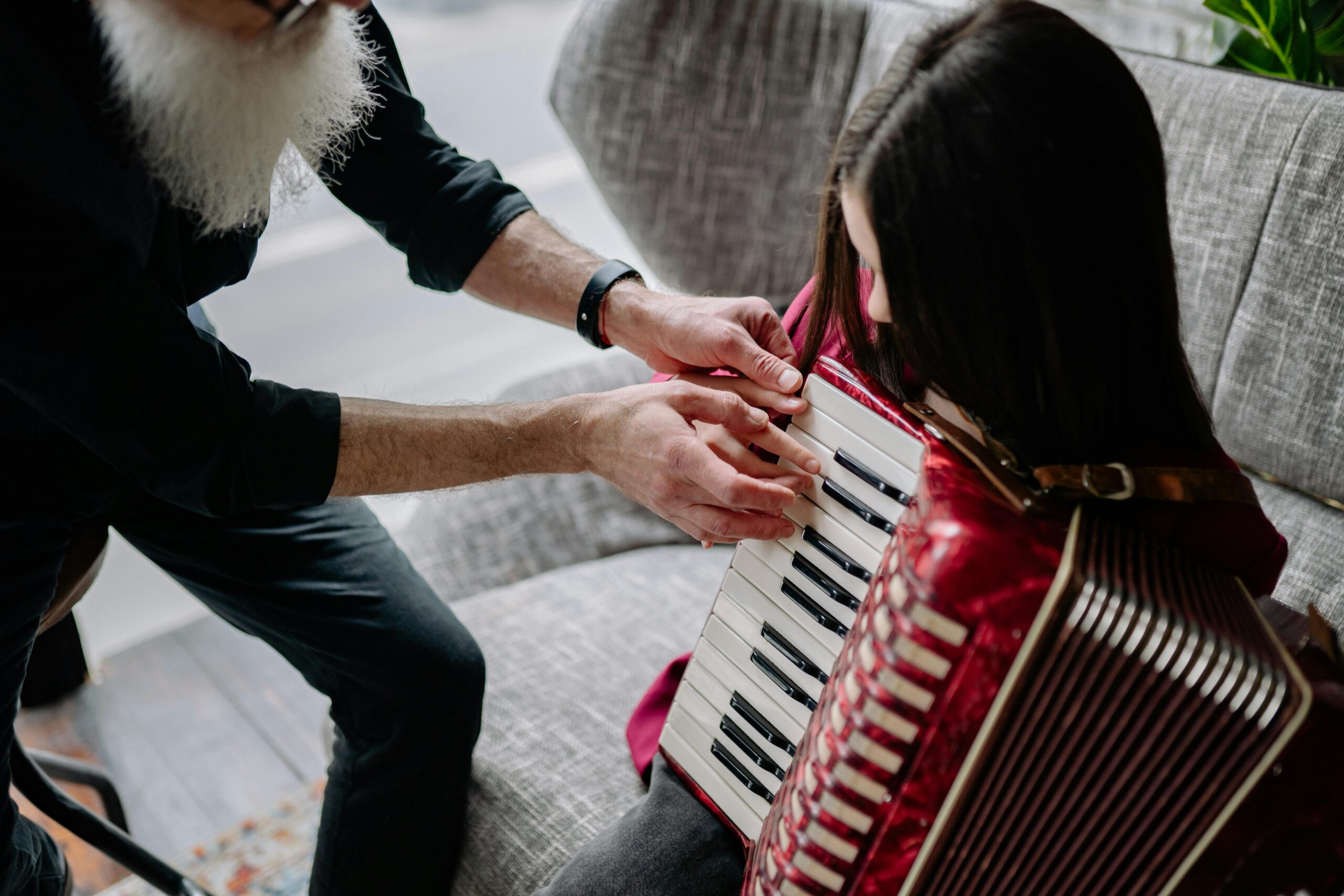
Self-teaching can work initially, but instruction from an experienced accordionist accelerates progress dramatically. Teachers identify technical issues before they become ingrained habits, provide personalized feedback, and keep you motivated through challenging periods.
Look for teachers with performance experience in your preferred genre. A classical accordion instructor may not understand the stylistic nuances of Cajun music, and vice versa. Many teachers now offer online lessons via video call, expanding your options beyond local instructors.
If private lessons exceed your budget, consider group classes or workshops. Community music schools, cultural centers, and accordion clubs often offer affordable group instruction. The peer learning environment provides additional motivation and social connection with fellow students.
Overcoming Common Beginner Frustrations
Bellows control challenges nearly every beginner. The accordion seems to wheeze, volume fluctuates unpredictably, and smooth sound remains elusive. Solution: slow practice focusing exclusively on bellows movement. Play single long notes while maintaining perfectly even volume for entire bellows strokes.
Bass button confusion creates another frustration point. Your left hand operates blind, searching for buttons by feel alone. This spatial awareness develops gradually through repetition. Mark your reference button with a small adhesive dot if needed, and practice bass patterns without melodies until muscle memory forms.
Physical fatigue affects beginners significantly. The accordion’s weight strains shoulders and backs unaccustomed to the load. Build endurance gradually—don’t practice through pain. Strengthen core muscles through general fitness to support better posture and longer comfortable playing sessions.
Expanding Your Musical Repertoire Strategically
Start with folk songs and simple melodies familiar to your ear. Pieces like “Oh! Susanna,” “Ode to Joy,” or traditional tunes from your cultural background provide achievable early goals. Familiarity with the melody helps you recognize mistakes and stay motivated as you hear recognizable tunes emerge.
Progress to pieces requiring both hands together once each hand functions independently. Simple waltz patterns (oom-pah-pah bass accompaniment) coordinate hands while remaining musically satisfying. Traditional waltzes and polkas serve as excellent stepping stones toward more complex arrangements.
Challenge yourself periodically with pieces slightly above your current level. This constructive struggle drives improvement, though balance is essential—too difficult and frustration kills motivation; too easy and boredom sets in. A good rule: 80% comfortable repertoire, 20% challenging material.
Exploring Different Accordion Music Styles 🌍
French musette epitomizes romantic Parisian cafe culture. Characterized by its swinging rhythm and liberal vibrato (achieved through special tuning), musette requires expressive bellows technique. Artists like Yvette Horner and Aimable define this beloved style.
Italian folk music showcases accordion’s Mediterranean roots. Tarantellas, saltarellos, and bel canto melodies demand quick fingerwork and dynamic expression. The accordion (fisarmonica in Italian) remains central to Italian cultural celebrations worldwide.
Eastern European traditions vary from polkas to Balkan brass band styles. Klezmer music brings Jewish cultural heritage to life through crying accordion melodies and energetic dance rhythms. Each regional style offers unique technical demands and cultural context worth exploring.
Caring for Your Accordion Investment
Proper storage protects your instrument from damage. Store accordions in climate-controlled environments away from extreme temperatures and humidity fluctuations. Cases should provide padding and support—never lay accordions flat for extended periods as this strains internal reed blocks.
Regular maintenance ensures optimal performance. Have professional technicians service your accordion annually, checking reed voicing, valve alignment, and bellows integrity. Between services, keep the instrument clean, wiping down keyboards and occasionally exercising bellows if stored for extended periods.
Transportation requires care. Use quality gig bags or hard cases with secure latches. When traveling by car, secure the accordion to prevent shifting, and never leave it in hot vehicles. Airlines classify accordions as musical instruments, though policies vary—research specific airline regulations before flying.
Joining the Global Accordion Community
Accordion festivals occur worldwide, celebrating the instrument through concerts, competitions, and workshops. Events like Cotati Accordion Festival (California), Accordion Noir (Texas), and various European festivals provide immersive experiences connecting you with master players and fellow enthusiasts.
Online communities offer year-round connection and support. Forums like Accordion.com and social media groups provide spaces to ask questions, share performances, and discuss technique. These virtual communities prove especially valuable for learners in areas without local accordion scenes.
Local accordion clubs exist in many cities, organizing jam sessions, performances, and educational events. Search for clubs through national organizations like the American Accordionists’ Association or Confédération Internationale des Accordéonistes to find regional groups near you.
Leveraging Technology in Your Practice Sessions 📱
Digital tuners help maintain your accordion’s pitch accuracy. While professional tuning requires expert service, tuners let you monitor your instrument’s condition and identify when professional attention becomes necessary.
Metronome apps develop rhythmic precision essential for ensemble playing and solo performances. Start practice tempos slower than performance speed, gradually increasing as accuracy improves. Consistent tempo practice with metronomes prevents rushing or dragging tendencies.
Sheet music apps like forScore or MuseScore provide portable libraries of accordion arrangements. Digital sheet music offers advantages like annotation capabilities, automatic page turning, and easy transposition—particularly helpful when learning pieces in different keys.
Setting and Achieving Musical Milestones
Goal-setting transforms abstract practice into purposeful preparation. Set specific, measurable objectives like “learn three new songs this month” or “perform at the community open mic night in six weeks.” Concrete goals provide direction and accomplishment markers along your journey.
Performance opportunities accelerate development dramatically. Playing for others—even small, informal gatherings—creates healthy pressure that reveals weaknesses and builds confidence. Start with supportive audiences (family, friends) before progressing to public performances.
Document your progress through journals or practice logs. Note what you practiced, challenges encountered, and breakthroughs achieved. This record reveals patterns in your learning, helps troubleshoot persistent issues, and provides retrospective appreciation of how far you’ve traveled.
Embracing the Joy of Musical Expression 🎶
Technical proficiency matters, but music ultimately serves emotional expression and human connection. Don’t postpone enjoyment until achieving perfection—that moment never arrives. Play imperfectly but expressively, sharing your music with others even while learning.
The accordion’s unique voice carries stories across generations and borders. When you play, you join centuries of accordionists who’ve brought joy to celebrations, comfort during hardships, and beauty to everyday moments. This heritage enriches every note you produce.
Your accordion journey belongs uniquely to you. Comparison with other musicians breeds unnecessary discouragement—focus instead on becoming better than yesterday’s version of yourself. Celebrate small victories, persist through challenges, and remember why you started: the pure love of music and the distinctive magic of the accordion.
Learning to play accordion transforms more than musical ability. It develops discipline, patience, cultural appreciation, and cognitive skills while connecting you to global communities of passionate musicians. The path requires commitment, but the rewards—personal growth, creative expression, and lifelong enjoyment—make every practice session worthwhile. Pick up your accordion, squeeze those bellows, and let your musical adventure begin today.
