
Anúncios
Learning to play the accordion opens up a world of musical possibilities, blending tradition with modern expression in a truly unique instrument.


The accordion has captivated audiences for centuries with its rich, expressive sound. From European folk music to contemporary jazz, this versatile instrument continues to inspire musicians worldwide. Whether you’re drawn to its nostalgic charm or its incredible range of musical styles, starting your accordion journey can be both exciting and rewarding.
Many aspiring musicians feel intimidated by the accordion’s apparent complexity, but with the right approach and consistent practice, anyone can master this beautiful instrument. This comprehensive guide will walk you through everything you need to know to begin playing accordion, from understanding its mechanics to developing your first melodies.
🎵 Understanding Your Accordion: Types and Components
Before diving into playing techniques, it’s essential to understand what type of accordion you’ll be working with. The two main categories are piano accordions and button accordions, each offering distinct advantages for different musical styles.
Piano accordions feature a keyboard similar to a piano on the right side, making them intuitive for anyone with piano experience. The left side contains bass buttons that produce bass notes and pre-set chords. This configuration is extremely popular in Western music and offers a familiar layout for beginners.
Button accordions, also called chromatic accordions or diatonic accordions, use buttons on both sides. These are common in folk music traditions across Europe, Latin America, and beyond. While the learning curve might be steeper initially, button accordions offer compact design and unique tonal qualities.
The bellows are the accordion’s lungs, creating airflow that produces sound. Learning proper bellows control is fundamental to playing expressively. The instrument also contains reeds – thin metal strips that vibrate when air passes over them, similar to a harmonica or reed organ.
🎯 Choosing the Right Accordion for Beginners
Selecting your first accordion requires careful consideration of several factors. Size matters significantly – full-size accordions can weigh 20-30 pounds, which might be challenging for younger players or those with physical limitations.
A 48-bass piano accordion represents an excellent starting point for most beginners. It offers sufficient range for learning fundamental techniques and playing simple songs without the overwhelming complexity of larger models. These instruments typically have 26 treble keys and provide adequate bass accompaniment capabilities.
Quality trumps quantity when investing in your first instrument. A well-maintained used accordion from a reputable brand often outperforms a cheap new model. Look for brands like Hohner, Roland, Weltmeister, or Scandalli when shopping.
Consider renting before buying if you’re uncertain about long-term commitment. Many music stores offer rental programs that apply payments toward eventual purchase. This approach lets you test whether accordion playing suits your musical interests without substantial upfront investment.
✋ Proper Posture and Holding Technique
Correct posture forms the foundation of comfortable, sustainable accordion playing. Sit upright in a sturdy chair without armrests, keeping your back straight and feet flat on the floor. The accordion should rest comfortably on your left thigh while shoulder straps support most of the weight.
Adjust the straps so the instrument sits securely against your body without restricting breathing or movement. Your right hand should reach the keyboard naturally, with your wrist straight and fingers curved. The left hand operates the bass buttons while maintaining the bellows control.
Never slouch or lean backward while playing, as this creates unnecessary strain and limits bellows movement. Your shoulders should remain relaxed, and your arms should move freely without tension. Taking regular breaks during practice prevents fatigue and helps maintain proper form.

🎼 Mastering the Bellows: Your First Priority
Bellows technique separates mediocre accordion players from skilled musicians. Think of the bellows as your breath – they control volume, expression, and phrasing. Smooth, controlled bellows movement creates beautiful, flowing music, while jerky or uneven motion produces choppy, unpleasant sounds.
Start practicing bellows control without playing any notes. Open and close the bellows slowly, maintaining consistent air pressure. Feel the resistance and learn to control the speed smoothly. This exercise builds the muscle memory essential for expressive playing.
Practice changing bellows direction seamlessly. The transition from pushing to pulling (or vice versa) should be imperceptible to listeners. Coordinate direction changes with musical phrases, typically occurring at natural breathing points in the melody.
Develop dynamic control by varying bellows pressure. Gentle pressure creates soft sounds, while increased pressure produces louder volumes. This technique allows you to shape musical phrases with crescendos and diminuendos, adding emotional depth to your performances.
🎹 Right Hand Technique: Playing Melodies
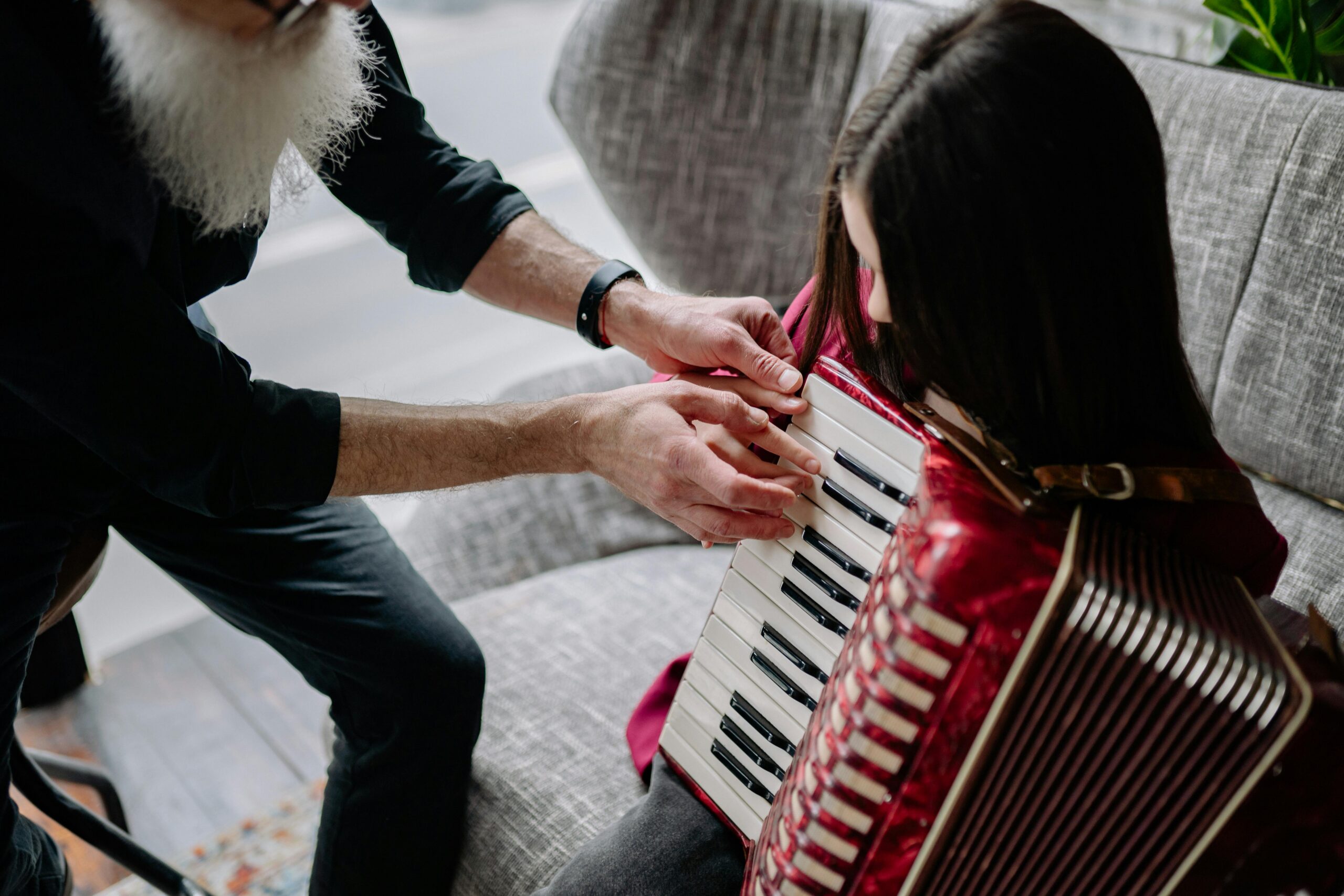
If you’re using a piano accordion, your right-hand technique closely resembles piano playing. Position your fingers over the keys with a natural curve, using the tips for optimal control. Number your fingers from 1 (thumb) to 5 (pinky) for reference in learning materials.
Begin with simple scales – C major is the traditional starting point. Practice slowly, focusing on even tone production and smooth finger transitions. Each note should sound clear and consistent, without accidental presses or muted tones.
Finger independence exercises dramatically improve your playing ability. Practice moving individual fingers while keeping others stationary. This skill becomes crucial when playing complex melodies with multiple voices or rapid passages.
Learn proper fingering patterns from the beginning. Using consistent, logical fingering makes songs easier to memorize and execute cleanly. Many method books provide fingering suggestions – follow these recommendations until you develop your own preferences based on hand size and comfort.
🎶 Left Hand Fundamentals: Bass and Chords
The left-hand button layout initially seems mysterious, but it follows a logical pattern called the Stradella bass system (on most accordions). The buttons are arranged in rows, with bass notes in the inner rows and chord buttons in the outer rows.
The fundamental bass row typically sits near the bellows strap. Learn to find the C bass button by feel – it often has a distinctive marker or indentation. From this reference point, you can navigate to other notes through muscle memory.
The standard Stradella system arranges buttons in the circle of fifths, moving chromatically as you move vertically. Horizontally, the rows represent different chord types: counterbass, bass, major chord, minor chord, seventh chord, and diminished chord.
Start practicing simple bass patterns with just one or two buttons. The classic “oom-pah” pattern alternates between a bass note and its corresponding major chord. This foundational accompaniment style appears in countless accordion pieces across multiple genres.
📚 Learning Your First Songs
Choose simple melodies with limited range and slow tempo for your initial repertoire. Traditional folk songs, children’s tunes, and basic classical pieces provide excellent starting material. “Mary Had a Little Lamb,” “Ode to Joy,” and “Amazing Grace” work wonderfully for beginners.
Break songs into small sections, practicing each part separately before combining them. Master the right-hand melody first, then add left-hand accompaniment. Finally, coordinate both hands with proper bellows control.
Use a metronome to develop steady rhythm and timing. Start at a comfortable slow tempo, gradually increasing speed as you gain confidence. Accuracy matters more than speed – playing correctly at slower tempos builds proper technique faster than rushing through mistakes.
Record yourself practicing to identify areas needing improvement. You’ll notice timing issues, uneven bellows control, or wrong notes that escape attention during playing. This objective feedback accelerates your learning progress significantly.
🎓 Developing a Practice Routine
Consistent daily practice outperforms occasional marathon sessions. Even 20-30 minutes daily produces better results than sporadic longer practices. Your brain and muscles need regular reinforcement to build lasting skills and memory.
Structure your practice sessions efficiently. Begin with warm-up exercises – scales, bellows control drills, and finger independence exercises. Spend the middle portion working on new material or challenging sections. End with pieces you play comfortably, leaving your practice session on a positive note.
Set specific, achievable goals for each practice session. Rather than vaguely “practicing,” target concrete objectives like “play the verse of Song X at 80 BPM without mistakes” or “master the bass pattern for the chorus.” This focused approach maximizes your limited practice time.
Track your progress in a practice journal. Note what you worked on, challenges encountered, and breakthroughs achieved. Reviewing this journal reveals patterns, celebrates progress, and maintains motivation during plateaus.
💡 Common Beginner Mistakes to Avoid
Many beginners develop bad habits that hinder progress and must be unlearned later. Gripping the accordion too tightly creates tension and fatigue. Stay relaxed – the straps support the instrument’s weight, not your hands.
Neglecting bellows technique represents another frequent error. Some students focus exclusively on pressing the right buttons while allowing bellows control to remain sloppy. Remember that bellows mastery defines your sound quality more than note accuracy alone.
Rushing through learning materials without mastering fundamentals leads to frustration. Build solid foundations with simple exercises and songs before attempting complex pieces. Skipping basics creates gaps in your technique that limit advanced playing.
Playing too loudly too often causes listener fatigue and prevents dynamic expression. Practice controlling volume through bellows pressure, developing the full dynamic range from whisper-soft to powerful forte.
🌟 Exploring Different Musical Styles
The accordion’s versatility shines across numerous musical genres. European folk traditions feature accordion prominently in French musette, Irish céilidh music, German polkas, and Italian tarantellas. Each style offers unique rhythmic patterns and melodic characteristics to explore.
Latin American music embraces accordion in styles like Argentine tango, Colombian cumbia, Mexican norteño, and Brazilian forró. These genres often feature rapid, syncopated rhythms and passionate melodies that showcase the accordion’s expressive capabilities.
Classical accordion repertoire has expanded dramatically in recent decades. Contemporary composers write sophisticated pieces specifically for accordion, while transcriptions of keyboard works by Bach, Scarlatti, and other masters provide rich musical challenges.
Jazz accordion playing combines harmonic complexity with improvisational freedom. Artists like Art Van Damme and Richard Galliano demonstrated the accordion’s potential in jazz settings, inspiring new generations of players to explore this fusion.
🎤 Performing and Sharing Your Music
Playing for others accelerates your development and builds confidence. Start by performing for supportive family and friends in low-pressure environments. Gradually expand to community events, open mic nights, or informal jam sessions.
Recording and sharing videos online connects you with the global accordion community. Platforms like YouTube, Instagram, and TikTok feature thriving accordion communities offering encouragement, feedback, and inspiration. Don’t worry about perfection – authenticity resonates more than flawless technique.
Consider joining local accordion clubs or ensembles. Playing with others develops timing, listening skills, and musical communication. Many cities host accordion groups welcoming players of all skill levels.
Attending accordion festivals and workshops provides immersion experiences that dramatically boost your abilities. These events offer master classes, concerts, and networking opportunities with passionate accordion enthusiasts worldwide.
🛠️ Maintaining Your Accordion
Proper maintenance ensures your accordion remains playable and retains its value. Store the instrument in its case when not in use, protecting it from dust, humidity extremes, and temperature fluctuations. Never leave an accordion in direct sunlight or near heating sources.
Clean the exterior gently with a soft, dry cloth after playing. Avoid harsh chemicals or excessive moisture that might damage the finish. The keyboard and buttons can be cleaned with slightly damp cloths, ensuring no water enters the instrument.
Have your accordion professionally serviced annually, especially if you play regularly. Technicians check reed alignment, valve condition, bellows integrity, and overall mechanical function. Preventive maintenance costs less than major repairs from neglect.
Monitor bellows condition carefully. Small air leaks dramatically affect playability and sound quality. If you notice the bellows losing pressure quickly or producing hissing sounds, consult a repair technician promptly.
📱 Using Technology to Enhance Learning
Modern technology offers powerful tools for accordion students. Mobile apps provide practice accompaniment, tuners, metronomes, and even virtual accordions for practicing fingering patterns away from your instrument. These digital resources supplement traditional learning methods effectively.
Online video lessons grant access to world-class instructors regardless of your location. Platforms like YouTube host thousands of free accordion tutorials covering every skill level and musical style. Paid subscription services offer structured curricula with progressive lesson plans.
Sheet music apps and websites provide instant access to vast repertoires. Digital scores often include audio playback features, helping you learn new pieces by ear before reading the notation. Many apps also slow down music without changing pitch, facilitating practice of challenging passages.
Connect with the global accordion community through social media groups and forums. These online spaces offer advice, troubleshooting help, and motivation during your learning journey. Experienced players generously share knowledge, creating supportive environments for beginners.
🚀 Setting Long-Term Goals
Envisioning your accordion playing future maintains motivation through challenging periods. Perhaps you dream of performing at local venues, joining a band, or simply entertaining at family gatherings. Clear goals provide direction and purpose for daily practice.
Set both short-term and long-term objectives. Short-term goals might include learning specific songs or mastering particular techniques within weeks or months. Long-term goals could involve performing publicly, recording an album, or achieving advanced proficiency over years.
Remain flexible and patient with yourself. Musical skill development follows non-linear paths with plateaus, breakthroughs, and occasional setbacks. Celebrate small victories and view challenges as opportunities for growth rather than obstacles.
Remember that learning accordion is a lifelong journey, not a destination. Even professional players continually refine their skills and explore new musical territories. Embrace the process, enjoy making music, and let your passion for the accordion guide your path forward.
🎊 The Joy of Playing Accordion
Beyond technical proficiency lies the true reward of accordion playing – the joy of creating music. This remarkable instrument connects you with rich cultural traditions while offering boundless creative possibilities. Each practice session brings you closer to expressing yourself through music.
The accordion community welcomes newcomers warmly, recognizing that every master player once started as a complete beginner. Your unique musical voice will develop naturally as you progress, combining learned techniques with personal interpretation and style.
Whether you aspire to professional performance or simply enjoy playing for personal satisfaction, the accordion rewards your dedication with lifelong musical fulfillment. The skills you develop – discipline, patience, creativity, and artistic expression – extend far beyond music into all areas of life.
Start your accordion journey today with enthusiasm and realistic expectations. Progress comes through consistent effort, not overnight miracles. With proper guidance, regular practice, and genuine passion, you’ll soon be creating beautiful music on this extraordinary instrument. The accordion awaits – it’s time to let your musical adventure begin! 🎵
